International Academic Report: Israel has begun practical steps to make the West Bank unlivable.
- The International Academic Campaign Against Israeli Occupation and Apartheid (IACAO) released its periodic report on the reality of apartheid and abuse of the Palestinian people during the month of October.
The report concludes that the Israeli occupation forces and settler militia seek through their oppressive policies to turn the West Bank into unlivable places. The report, prepared by researcher Ahmed Taqatqa, included several military measures carried out by the occupation forces and settler groups in the West Bank with the aim of harassing Palestinians and forcing them to migrate out of their villages and cities.
Among these measures included in the report:
1- Land confiscation. Which included issuing many military orders to confiscate land from Palestinians, so that the total area for which the occupation authorities issued military orders amounted to 83,705 dunums of land in Jenin governorate, Jerusalem, Salfit and others.
2- Settler Terrorism: Since the beginning of October 2024, the UN Office for the Coordination of Humanitarian Affairs (OCHA), the Wall and Settlement Resistance Authority (WSA) and other organizations have documented some 360 settler-related incidents in some 90 Palestinian communities across the West Bank, 60 per cent of which were related to the olive harvest season. Of these incidents, 104 resulted in injuries and property damage.
3- Expansion of funding for settlement outposts by the Israeli government. 43 new settlement outposts have been established in the West Bank since October 7, most of which are agricultural outposts, and although these outposts are illegal under the law of the Israeli colonial authorities, several international organizations confirmed that these outposts were funded by the government with 28 million shekels in 2023 and allocated 75 million shekels for the year 2024 and approved the construction of 70 new colonial outposts.
4- Preventing Palestinian farmers from harvesting olives. The occupying forces doubled down on restrictions on Palestinian farmers during the olive harvest season. Since October 1, the UN Office for the Coordination of Humanitarian Affairs (OCHA) has documented at least 300 incidents in which Israeli forces attacked Palestinians and restricted their access to agricultural land, affecting at least 700 people.
5-During the period covered by the report, 15 structural plans were approved and deposited, all of which seek to expand colonization and add a large number of housing units in illegal settlements, as 7 new plans were approved and 8 structural plans were deposited that are under consideration for implementation in the West Bank and Jerusalem. In total, they aim to build 1151 housing units on 504 dunams in the West Bank and East Jerusalem, and the structural plans within Jerusalem city limits aim to build 500 housing units on an area estimated at 107 dunams of citizens' land.
6- The use of excessive force by settler gangs and the occupation army. During this reporting period, Israeli settlers and the occupation authorities launched a total of 1490 attacks, compared to 1344 attacks from the previous month, an increase of about 11%, resulting in deaths and property damage. Some 670 trees were vandalized and their crops stolen. Since the beginning of October 2024, some 180 settler-related incidents have been documented, affecting nearly 90 communities. According to official data, during the month of October, 48 Palestinians were martyred in the West Bank and around 450 were injured. As of October 1, more than 10,000 Palestinian prisoners were captured and about 2,000 Palestinians were displaced from their homes as a result of the genocidal policy carried out by the occupation forces in the West Bank.
7- The imposition of a temporal and spatial apartheid system, whereby almost all roads between Palestinian cities are almost completely closed using fixed and mobile military checkpoints, and in the same context, time regulations are imposed for the passage of Palestinian Arab cars between these cities, for several purposes, most importantly to justify the protection of settlers and minimize opportunities for spatial communication with Palestinians, and these discriminatory measures aim to hinder the daily life of Palestinians and prevent them from going to their jobs, universities and lands.
 > " السيادة المعرفية في مواجهة الأبرتهايد: إعادة إعمار التعليم العالي في غزة بين السيطرة المكانية وإنتاج المعرفة (202 ..
 The Reshaping of Palestinian Space Under the Israeli Apartheid System by Mr. Ahmad Takatka
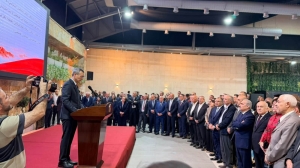 مشاركة الحملة الاكاديمية الدولية في مناسبة الذكرى الـ77 لتأسيس جمهورية الصين الشعبية
 تقرير: الحواجز العسكرية وإعادة تشكيل الجغرافيا الفلسطينية
 ندوة في رام الله تدعو لترجمة المواقف الدولية تجاه فلسطين إلى قوة فاعلة
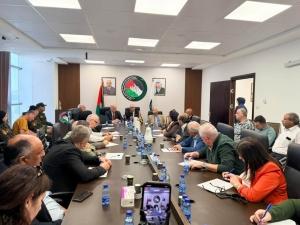 ندوة سياسية: ضرورة تحويل التحولات الدولية إلى قوة فلسطينية فاعلة وتجسيد الدولة
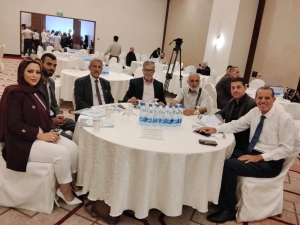 ورشة عمل دائرة شؤون اللاجئين في منظمة التحرير الفلسطينية
 عذراً هاكابي… أنت لا تفهم القانون الدولي جيداً !
 وفد فلسطيني يشارك في برنامج خبراء الدراسات الصينية ودول الحزام والطريق